EN
EN
 jp
jp  ko
ko  fr
fr  de
de  es
es  it
it  ru
ru  pt
pt  ar
ar  th
th 
For men's incontinence pads, the optimal SAP-to-fluff pulp ratio is not a fixed number. It depends on the absorbency level, pad thickness, target cost, liquid acquisition speed, rewet performance, and the user scenario. In a professional male Guard design, SAP provides high liquid retention, while fluff pulp supports fast intake, liquid distribution, softness, and core stability.
As an OEM starting point, light-protection male guards may use a fluff-rich core, moderate daily-use pads often use a more balanced fluff pulp and SAP structure, while higher-absorbency men's pads may increase SAP content with stronger ADL and core-wrap support. The final ratio should always be validated by absorption, rewet, pressure, leakage, and wearing-simulation tests.
SAP and fluff pulp serve different but complementary roles in a male Guard. SAP, or Super Absorbent Polymer, absorbs liquid and locks it into a gel-like form. This helps reduce surface wetness and improves retention under pressure.
Fluff pulp is a soft cellulose fiber material. It helps receive liquid quickly, distribute it across the core, support pad shape, and create a soft cushion-like feel. Without enough fluff pulp or distribution structure, urine may concentrate in one area, increasing the risk of gel blocking, slower acquisition, and local leakage.
| Material | Main Function | Impact on Product Performance |
|---|---|---|
| SAP | Locks liquid into the absorbent core | Improves retention, dryness, thinness, and absorbency capacity |
| Fluff pulp | Absorbs and distributes liquid quickly | Improves intake speed, softness, structure, and core stability |
| SAP + fluff pulp core | Balances speed and retention | Supports practical leakage control in daily-use male incontinence pads |
No. More SAP can improve theoretical liquid retention, but it does not automatically create a better men's incontinence pad. A high-SAP core may become thinner and more absorbent on paper, but if the liquid cannot spread efficiently, the pad may absorb slowly or leak before SAP reaches full capacity.
Excessive SAP may also increase the risk of gel blocking. This happens when swollen SAP particles restrict liquid flow, causing urine to stay near the entry point instead of spreading through the core. For male users, this is especially important because leakage is usually concentrated in the front absorbent zone.
A reliable male Guard needs enough SAP for retention and enough fluff pulp or ADL support for fast intake and distribution.
The optimal ratio should be selected according to product positioning. The following ranges can be used as initial OEM development references, not fixed universal formulas.
| Product Positioning | Suggested SAP-to-Fluff Direction | Typical Design Goal | Best Use Scenario |
|---|---|---|---|
| Light protection male Guard | Higher fluff pulp, moderate SAP | Fast acquisition, soft feel, slim daily comfort | Occasional dribble or light urinary leakage |
| Moderate protection male Guard | Balanced SAP and fluff pulp | Good balance of absorption, dryness, and thickness | Daily active use, work, travel, and routine leakage control |
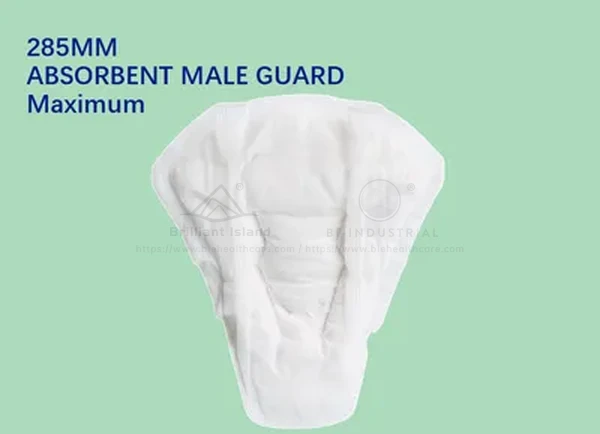
| Maximum protection male Guard | Higher SAP with stronger distribution design | Higher retention, lower rewet, longer wearing support | Moderate leakage, longer use, or stronger protection needs |
In practical manufacturing, many standard absorbent cores are designed around a balanced relationship between pulp and SAP. However, modern thinner products often increase SAP content while using improved ADL, core wrapping, embossing, and adhesive stabilization to maintain acquisition and structure.
For OEM sourcing, ratio planning should follow the pad's absorbency level and user expectations. A light pad should not feel bulky. A maximum-protection pad should not leak under pressure. Each segment needs a different core logic.
For light dribble protection, the product should remain thin, soft, and easy to wear inside close-fitting underwear. A fluff-rich structure can improve quick intake and comfort, while a moderate SAP level helps lock moisture away.
This type of male Guard is suitable for users who need discreet daily protection but do not require high-capacity absorption.
Moderate men's incontinence pads require a more balanced core. The product must absorb repeated small leakage events, maintain surface dryness, and remain stable during walking, sitting, and daily movement.
For this segment, a balanced SAP and fluff pulp structure is often the most commercially practical choice. It supports reliable performance without making the pad too thick or too expensive.
For maximum protection designs, SAP content may be increased to improve retention capacity. However, the core must also include better distribution support. This can include ADL optimization, channel embossing, core wrapping, barrier cuffs, or improved SAP particle distribution.
A high-SAP male Guard without enough distribution support may look attractive in specification sheets but perform poorly in real-use leakage tests.
Too much fluff pulp can make a men's incontinence pad thicker and softer, but it may reduce discretion and create a bulkier wearing experience. While fluff pulp supports fast absorption and comfort, it does not retain liquid under pressure as effectively as SAP.
Common problems with excessive fluff pulp include:
Thicker pad profile
Lower discretion under clothing
Higher rewet risk under pressure
Potential core deformation after wetting
Less efficient use of absorbent capacity
For active male users, excessive bulk can reduce acceptance even if the product feels soft. This is why OEM design must balance user comfort with real absorbency performance.
Too much SAP can create a thinner and higher-capacity product, but it may also create performance risks if the core is not properly engineered. SAP needs enough space and structure to swell. If SAP particles are too concentrated, liquid movement may slow down.
Common risks include:
Gel blocking near the liquid entry point
Slower repeated absorption
Uneven swelling
Hard or lumpy wet core feel
Higher material cost
Greater dependence on ADL and core-wrap design
For a male Guard, the front absorption area must perform quickly because leakage often occurs in a focused zone. High SAP loading must therefore be supported by a liquid-spreading design.
The Acquisition Distribution Layer (ADL) can change how much SAP a product can use effectively. ADL helps receive liquid from the top sheet and distribute it across the absorbent core. This improves acquisition speed and reduces the chance of localized saturation.
When ADL performance is strong, the core may support a higher SAP ratio while maintaining faster absorption. When ADL is weak or absent, the product often needs more fluff pulp to compensate for distribution and intake.
Other core design factors also influence the ideal ratio:
Embossing channels: Guide liquid movement and improve core stability.
Core wrap: Keeps fluff pulp and SAP contained during production and use.
SAP particle size: Affects absorption speed, retention, and gel blocking risk.
Core density: Influences liquid flow, softness, and swelling space.
Pad shape: Determines where the absorbent core should be concentrated.
OEM buyers should avoid judging a men's incontinence pad only by SAP percentage or total absorbency claims. A well-designed male Guard should be tested under conditions close to real use.
Key evaluation items include:
Acquisition time: How quickly the pad absorbs liquid after each insult.
Rewet value: How much liquid returns to the surface under pressure.
Retention under pressure: Whether the core holds liquid when the user sits or moves.
Distribution length: Whether urine spreads across the core or stays in one zone.
Leakage edge test: Whether liquid escapes from the sides or front area.
Thickness after absorption: Whether the pad remains comfortable and discreet.
Core integrity: Whether the core breaks, clumps, or shifts after wetting.
For private label buyers, sample testing should compare both dry-state comfort and wet-state performance. A pad that feels soft when dry may still fail if the core collapses or rewets after use.
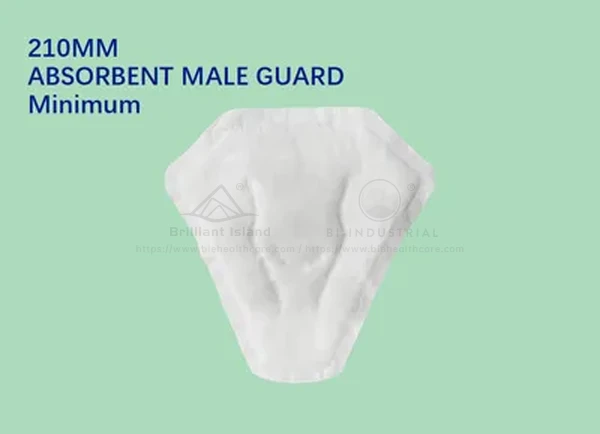
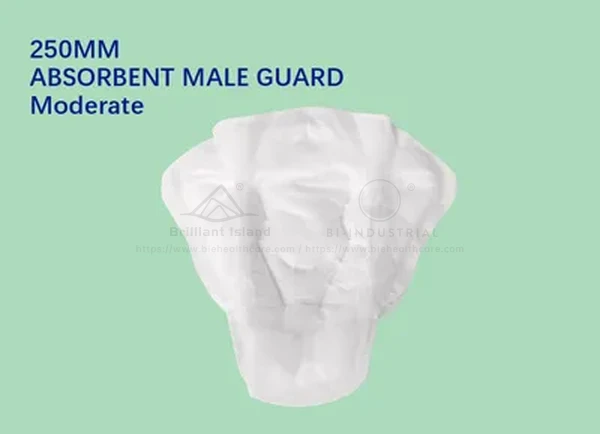
BI-Ehealthcare provides OEM and ODM solutions for men's incontinence pads, including male Guard products with different size and absorbency options. The product range can support minimum, moderate, and maximum protection positioning, helping brands build a complete male leakage-care lineup.
For buyers developing a new private label product, the SAP and fluff pulp ratio should be matched with:
Target absorbency level
Pad length and shape
Thickness requirement
Retail price positioning
Packaging format
Regional user preferences
Channel type, such as pharmacy, supermarket, healthcare distributor, or e-commerce
The right core structure helps improve user confidence, reduce leakage complaints, and build long-term product competitiveness.
SAP and fluff pulp are not competing materials in men's incontinence pads. They work together. SAP provides liquid retention and dryness, while fluff pulp supports acquisition, distribution, softness, and structural stability.
The best SAP-to-fluff pulp ratio for a male Guard depends on the target absorbency level, user scenario, thickness requirement, and real-use performance test results. For OEM buyers, the most reliable approach is to define the product segment first, then optimize the absorbent core through lab testing, sample comparison, and user-focused performance evaluation.
SAP stands for Super Absorbent Polymer. It absorbs urine and locks it into a gel-like form inside the core, helping reduce surface wetness and leakage.
Fluff pulp helps absorb liquid quickly, distribute it through the core, provide softness, and support the pad's structure during use.
Neither material is better on its own. SAP improves retention and dryness, while fluff pulp improves intake, comfort, and liquid distribution. A good men's incontinence pad uses both in the right balance.
More SAP can increase retention capacity, but too much SAP may cause gel blocking or slower liquid distribution if the core is not properly designed.
OEM buyers should define the target absorbency level, request sample structures, and test acquisition speed, rewet, retention under pressure, leakage control, and core stability.
Yes. The ratio can be customized according to product size, absorbency level, pad thickness, target cost, and private label market positioning.
*BI-Ehealthcare makes no warranties or representations regarding the completeness or accuracy of the information. This information should be used only as a guide and should not be relied upon as a substitute for professional medical or other health professional advice.
*Contact us:https://www.bi-ehealthcare.com/contact-us.html